Here is a number that changed how I think about document formats. A 500-word article costs an AI roughly 700 tokens in clean Markdown. The same 500 words, wrapped in typical HTML with its divs, classes, and attributes, cost around 2,100 tokens. Same content, three times the price.
I sit on both sides of the Markdown vs HTML5 for AI debate every single day. Every MetaBlogue article starts life as a Markdown file in my content workspace, and WordPress converts it to HTML5 the moment I publish. So this is not a theoretical comparison for me — it is my actual workflow.
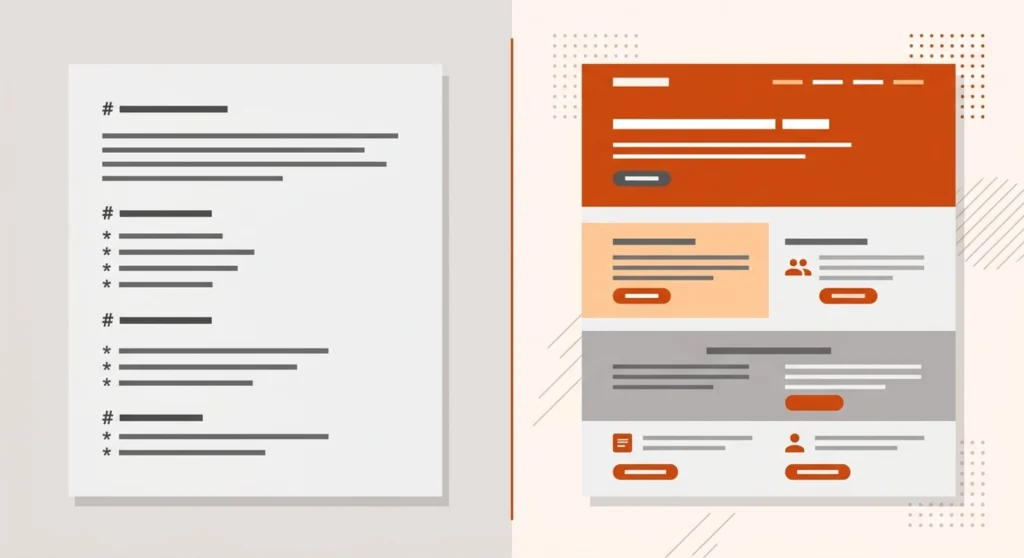
In this post, I will compare both formats on the two axes that matter: what AI pays to read your content, and what humans gain when they read it. I will also cover spec-driven development, because that is where this choice has the biggest practical impact right now.
What Is the Markdown vs HTML5 Debate About?
Markdown vs HTML5 for AI is the choice between a lightweight plain-text format (Markdown) and the full web markup language (HTML5) when preparing content that both AI models and humans will read. Markdown optimizes for machine ingestion and raw-text readability, while HTML5 optimizes for rendered presentation, rich semantics, and interactivity.
The two formats were never meant to compete. HTML arrived in 1990 to build the web. Markdown arrived in 2004 as a shortcut for writing that web content without typing tags.
Then large language models showed up, and suddenly the format of your documents had a price tag attached. Every character you feed an AI becomes tokens, and tokens are what you pay for — in money, in latency, and in context window space. That turned an old formatting preference into a genuine architecture decision.
The Token Cost: What AI Pays to Read Your Words
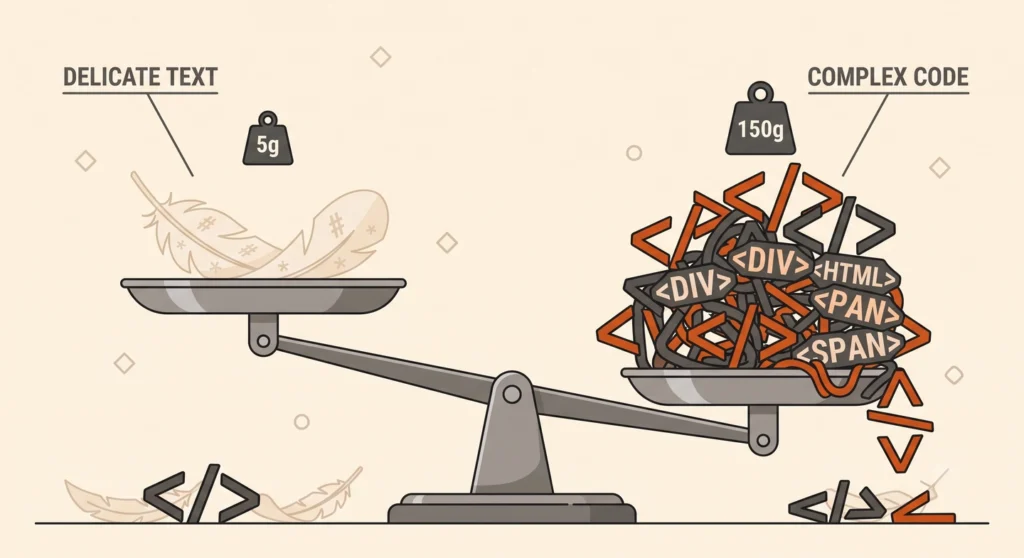
Tokens are the units an AI model reads text in — roughly three-quarters of a word each. Both the API bill and the context window are measured in them, so a verbose format costs you twice.
Converting HTML to Markdown reduces token usage by roughly 68% for clean content, and up to 87% for real-world web pages. The reason is simple: HTML wraps every heading in <h1> tags, every list item in <li>, and every section in nested divs with class names, while Markdown marks the same structure with a # or a -. For you, that means the same context window holds nearly three times more knowledge in Markdown than in HTML.
Here is how the overhead breaks down:
| Scenario | HTML5 cost vs Markdown |
|---|---|
| Clean, well-structured content | 2–3x more tokens |
| Real-world pages (divs, classes, inline scripts) | 8–10x more tokens |
| A 500-word article | ~2,100 tokens vs ~700 |
Now, the processing side follows the same curve. More tokens mean slower responses and higher compute per request. If you are running a RAG pipeline or an agent that reads documents all day, that 3x multiplier compounds on every single call. I saw this first-hand when I did the token math on skills vs MCP servers — format overhead is rarely where you think it is, but it always shows up on the bill.

Does Markdown Actually Improve AI Accuracy?
Markdown improves AI accuracy for most text tasks, not just cost. In GPT-based table extraction tests, Markdown scored around 60.7% accuracy against 53.6% for HTML tables. RAG pipelines report accuracy improvements of up to 35% when ingesting Markdown instead of raw HTML.
The mechanism makes sense once you think about it. Verbose tags and attribute noise sit between the model and the actual content, diluting its attention. Strip the noise, and the model spends its capacity on your words instead of your markup.
Though, be honest about the limits here. These benchmarks vary by model and task, and frontier models keep getting better at parsing messy HTML. The gap is real today, but I would treat the exact percentages as directional rather than gospel.
The Human Side: Readability and Ease of Access
This is where HTML5 earns its keep. A rendered HTML5 page gives humans typography, spacing, images, responsive layout, and colour — and our brains are heavily wired for visual processing. Nobody wants to read a 2,000-word article as plain text with hash marks in front of the headings.
But raw Markdown has its own kind of human readability, and I think it is underrated. Open a Markdown file in any text editor — Notepad, VS Code, your phone — and you can read it comfortably with zero tooling. Try that with raw HTML and you are wading through angle brackets.
That accessibility is why I keep all my knowledge in Markdown files. There is no build step, no database, no rendering engine between me and my own content. The same file that an AI reads cheaply, I can read on any device I will own for the next twenty years. HTML5 is human-first only after a browser renders it; Markdown is human-readable the moment you open it.
Where HTML5 Still Beats Markdown
I do not want this to read like a Markdown victory lap, because HTML5 does things Markdown simply cannot.
Semantics and accessibility — HTML5 elements like <article>, <nav>, and <figure>, plus ARIA attributes, build the accessibility tree that screen readers depend on. Interestingly, browsing AI agents lean on that same tree, which means semantic HTML5 serves both audiences at once.
Structured data — Schema.org markup, Open Graph tags, and microdata live in HTML. Markdown has no native way to tell a search engine “this is a recipe” or “this is a product review”.
Diagrams and visuals — HTML5 renders inline SVG with full control over colours, labels, and even animation, which makes architecture diagrams and flowcharts genuinely readable for humans. Markdown can embed diagrams through Mermaid, but the support is renderer-dependent — it works on GitHub, breaks elsewhere — and you get almost no control over colours or styling. When I need a diagram that explains something at a glance, Markdown is not where I build it.
Interactivity — Forms, embedded tools, dashboards, and anything a reader clicks or types into needs HTML5. Markdown describes documents; it cannot describe behaviour.
Fidelity — Markdown is lossy. Convert a complex HTML page to Markdown and you drop data attributes, nested layouts, and metadata that may have carried meaning. For agent-to-human output where visual clarity matters, HTML wins even at 3x the token price.
One caution if you go the HTML5 route: dynamic content. Anything JavaScript injects after the page loads is a problem for AI readers. Most AI crawlers never execute scripts, so client-rendered content is simply invisible to them — and the agents that do run a headless browser pay for it in extra processing time and tokens. Markdown never has this failure mode, because it is a flat sequential file; what you see is everything there is. So if your HTML5 pages carry content AI should read, make sure it is server-rendered, and keep the dynamic parts limited to features humans actually interact with.
So the honest framing is not “which format is better” but “which direction is the content flowing”. Into an AI: Markdown. Out to a human’s screen: HTML5.

Spec-Driven Development: Markdown’s Quiet Takeover
Spec-driven development means writing a clear specification of what you want built — requirements, constraints, acceptance criteria — and letting AI coding tools work from that document instead of from vague chat prompts. The spec becomes the source of truth, and the code follows it.
Look at what the entire industry chose for these specs: AGENTS.md, CLAUDE.md, SKILL.md, README.md, and the spec files in tools like GitHub’s Spec Kit. Every one of them is Markdown. Not one major AI coding tool asks for specs in HTML.
That was not an accident. A spec gets read by the AI on almost every request, so token efficiency matters enormously — a spec at 3x token cost is a tax on every task. Specs also live in git, and Markdown diffs cleanly line by line, which HTML with its nested tags does not. And both the human and the AI need to edit the same file without a build step getting in the way.
I have written before about setting up guardrail files for AI coding projects and creating agent skills, and the pattern holds everywhere: when a document’s job is to be read by machines and maintained by humans, Markdown wins without a fight. If your team is still writing specs in Word documents or Confluence pages, converting them to Markdown files in the repo is the single easiest upgrade to your AI workflow.
How I Handle Both Formats on MetaBlogue

My own setup is a one-way pipeline, and I would recommend the same shape to anyone publishing content today.
I write and refine every article as a Markdown file. That workspace is where AI tools help me research, edit, and cross-link — all at Markdown token prices. When an article is ready, WordPress turns it into semantic HTML5 with proper schema markup for search engines. Humans get the rendered, styled, visual version; my AI workflow never touches HTML at all.
There is also an emerging standard worth knowing: llms.txt proposes that websites offer a Markdown index — and Markdown versions of key pages — specifically for AI crawlers. Your human visitors get HTML5, and visiting AI agents get the same content at a fraction of the token cost. It is early days, but the direction is clear: the web is quietly growing a machine-readable Markdown layer alongside its human-facing HTML one.
In practice, the rule I follow is this: author in Markdown, generate HTML5, and never hand-maintain the same content in both. The moment you maintain two copies, they drift apart.
Which Format Should You Use? A Quick Decision Table
| Situation | Use |
|---|---|
| Specs, agent instructions, project guardrails | Markdown |
| Knowledge bases and notes AI will read | Markdown |
| Content scraped for RAG pipelines | Convert to Markdown first |
| Published web pages for readers | HTML5 (generated from Markdown) |
| Interactive tools, forms, dashboards | HTML5 |
| Diagrams and visual explanations | HTML5 (inline SVG) |
| Accessibility and structured data for search | HTML5 |
If you only remember one thing: match the format to the reader. Machines and plain-text humans get Markdown. Browsers and rendered-page humans get HTML5.
Final Thoughts
Markdown and HTML5 are not rivals — they are two ends of the same pipeline. Markdown is the format you think, write, and instruct in; HTML5 is the format you present in. The mistake is making AI read your presentation layer, or making humans read your storage layer.
Start small: take one document your AI tools read regularly — a spec, a style guide, a knowledge file — and convert it from HTML or Word to plain Markdown. Then watch your token usage drop. That one change will tell you more than any benchmark I can quote.
FAQ about Markdown VS HTML5
Is Markdown better than HTML for AI?
Markdown is better than HTML for AI ingestion in most cases. It uses roughly 68% fewer tokens for the same content and improves extraction accuracy in benchmarks. HTML is better when the AI’s output needs to be visually rendered for humans, or when semantics like ARIA and schema markup matter.
Why does HTML use more tokens than Markdown?
HTML uses more tokens because every structural element requires opening and closing tags, plus attributes and class names. A heading in Markdown is one # character; in HTML it is <h1 class="title"> and </h1>. Real-world pages add nested divs and inline styles, pushing the overhead to 8–10x.
Should I write AI specs in Markdown or HTML?
AI specs should be written in Markdown. Every major AI coding tool — Claude Code, Cursor, Copilot — reads Markdown instruction files like AGENTS.md natively. Markdown specs cost fewer tokens on every request, diff cleanly in git, and stay editable by both humans and AI without any tooling.
Can AI still read HTML websites?
AI can read HTML websites, just less efficiently. Models parse HTML fine, but the tag overhead consumes 2–10x more tokens and can dilute accuracy on structured content. JavaScript-rendered content is the bigger risk — most AI crawlers never execute scripts, so dynamic content can be invisible to them entirely. Many AI tools convert pages to Markdown before processing, and the llms.txt standard lets sites offer Markdown versions directly.
What is llms.txt?
llms.txt is a proposed web standard where a site places a Markdown file at /llms.txt that gives AI systems a concise, machine-friendly map of its important content. It lets websites serve humans rich HTML5 pages while offering AI crawlers the same information at a much lower token cost.