I had a blog post that targeted the perfect keyword. Decent search volume, low competition, and I’d followed every on-page SEO checklist I could find. The keyword sat in the title, the first paragraph, the H2s, the meta description. Textbook execution.
It ranked on page 3 for six months and never moved.
The problem wasn’t the keyword. The problem was that I’d written an in-depth tutorial when everyone searching that term wanted a quick comparison table. I was answering the right question in the wrong format — and Google knew it.
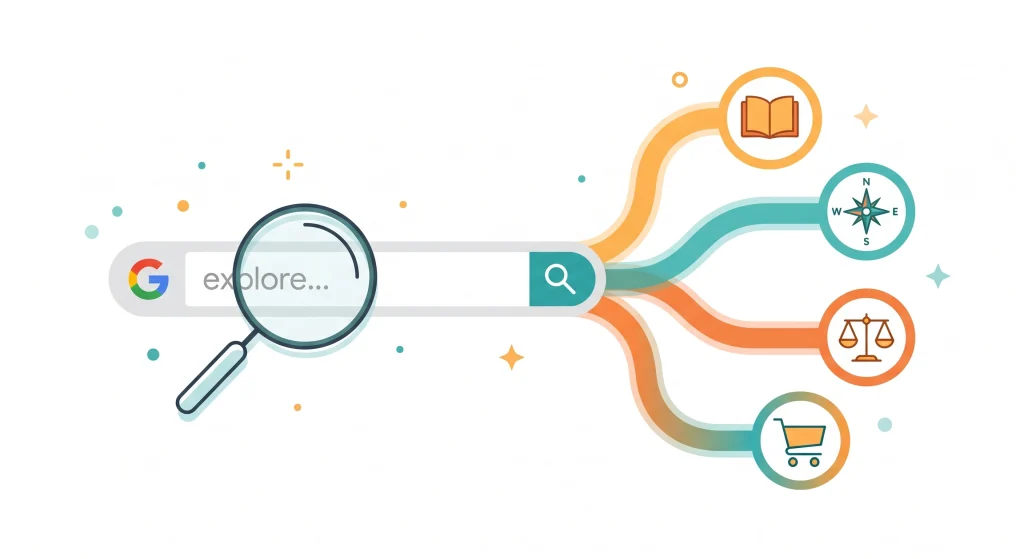
That’s when I started paying attention to search intent. Once I understood what it was and how to spot it, my approach to every article changed. This is the guide I wish I’d had before wasting months on content that was technically optimized but fundamentally mismatched.
Table of Contents
What Is Search Intent?
Search intent is the reason behind a search query — not the words someone types, but what they are actually trying to accomplish. It answers the question: what does this person want to do, learn, find, or buy right now?
Understanding search intent means looking past the keyword itself and asking what outcome the searcher expects. Two people can type the same words into Google and want completely different things. The keyword tells you the topic. The intent tells you what to write.
Why Search Intent Matters More Than Keywords
Google stopped being a keyword-matching engine years ago. Its systems now evaluate whether your page satisfies the purpose behind a query — not just whether it contains the right words.
This is the single biggest shift in SEO that many bloggers still haven’t internalized. You can nail your keyword research, find a term with perfect volume and low competition, and still rank nowhere if your content doesn’t match what the searcher actually wants.
Here’s what happens when intent is mismatched: a reader clicks your result, doesn’t find what they expected, and hits the back button within seconds. Google tracks this behavior. When enough people bounce back to the search results and click a different link instead, Google interprets it as a signal that your page didn’t satisfy the query. Over time, your ranking drops — regardless of how many keywords you included.
I’ve seen this on MetaBlogue firsthand. An article with strong keyword placement that consistently lost ground to a shorter, simpler article from a smaller blog — because that article gave readers exactly what they were looking for. Not more content. The right content.
The myth that keyword density drives rankings is partly rooted in this misunderstanding. Keywords get you into the conversation. Intent decides whether you stay.
The Four Types of Search Intent

Every search query falls into one of four categories. Once you learn to recognize them, you’ll start seeing intent patterns everywhere — in your own Search Console data, in your competitors’ content, and in the way Google structures its results pages.
Informational Intent
The searcher wants to learn something. They’re not ready to buy, sign up, or visit a specific website. They want an answer, an explanation, or a guide.
Example queries: “what is search intent,” “how to start a blog,” “why is my website slow”
What Google shows: Articles, tutorials, how-to guides, knowledge panels, People Also Ask boxes, and videos. The results are heavy on educational content.
What to create: In-depth guides, how-to articles, explainer posts, and FAQ-driven content. This is where most blog content lives — and where bloggers have the strongest natural advantage.
Navigational Intent
The searcher already knows where they want to go. They’re using Google as a shortcut to reach a specific website or page.
Example queries: “WordPress login,” “Google Search Console,” “RankMath settings”
What Google shows: The target website’s homepage or specific page at position 1, followed by related pages from the same site.
What this means for bloggers: You generally can’t rank for navigational queries unless they’re pointing to your own site. Don’t waste time targeting them. But do make sure your own brand name and key pages rank for navigational searches about your blog — if someone searches “MetaBlogue SEO tips,” my site should be the first result.
Commercial Investigation Intent
The searcher is researching before making a decision. They’re comparing options, reading reviews, or evaluating whether something is worth buying. They haven’t committed yet.
Example queries: “best WordPress themes 2026,” “GeneratePress vs Astarter,” “is RankMath worth it”
What Google shows: Comparison articles, “best of” roundups, detailed reviews with pros and cons, and listicles. You’ll often see tables and star ratings in the results.
What to create: Comparison posts, honest reviews with real experience, “best X for Y” articles, and pros/cons breakdowns. The key word here is honest — readers at this stage are actively looking for reasons to trust or distrust a product. One-sided promotional content stands out immediately, and not in a good way.
Transactional Intent
The searcher is ready to act. They want to buy, download, sign up, or complete a specific action right now.
Example queries: “buy GeneratePress premium,” “download WordPress,” “sign up Mailchimp free plan”
What Google shows: Product pages, pricing pages, signup forms, and ads. Very few blog articles appear here — the results are dominated by the actual service or product pages.
What this means for bloggers: Most bloggers don’t create transactional content because they don’t sell products directly. But if you have a product, a course, or an affiliate relationship, understanding transactional intent helps you create landing pages that match what ready-to-buy searchers expect.

Not Sure What to Blog About? Here’s How to Find Topics That Actually Work
How Google Figures Out What You Want
Google doesn’t just read the words in your query. It uses several layers of analysis to determine intent — and it gets better at this every year.
Query language patterns. Words like “how to,” “what is,” and “why does” signal informational intent. Words like “best,” “vs,” “review,” and “top” signal commercial investigation. Words like “buy,” “price,” “discount,” and “download” signal transactional intent. Google has processed billions of queries and has mapped these patterns thoroughly.
Click behavior. When Google shows results for a query, it watches what happens next. If most people click on tutorial-style articles and spend several minutes reading, Google learns that this query has informational intent. If most people click on product pages and leave quickly (because they completed a purchase), that signals transactional intent. This behavioral data continuously refines how Google categorizes intent.
SERP composition itself. This is the most useful signal for bloggers. Google has already done the intent analysis for you — the results page shows you the answer. If you search a keyword and see mostly blog posts, how-to guides, and videos, Google has decided this is an informational query. If you see product pages, pricing tables, and shopping results, it’s transactional. The SERP is Google’s public verdict on intent.
I use this constantly. Before writing any article, I search the target keyword in an incognito window and study what Google is actually showing. Not what I think the intent should be — what Google has already determined it is.
How to Identify Search Intent for Any Keyword
Identifying intent isn’t guesswork. There’s a reliable three-step process I follow for every keyword before I commit to writing an article.
Step 1: Search the Keyword and Study the SERP
Open an incognito browser window and search for your target keyword. Look at the top 10 results and answer three questions:
What type of content dominates? Are the results mostly blog posts? Product pages? Videos? Comparison articles? The dominant format tells you what Google expects for this query.
What format do the top results use? Within the content type, look at the specific format. Are the top-ranking articles step-by-step guides, listicles, long-form tutorials, or short answer posts? If the top 5 results are all listicles, publishing a narrative essay is fighting the format Google has validated.
What angle do they take? Look at the titles and H1s. Are they aimed at beginners or experts? Are they focusing on cost, speed, quality, or simplicity? The angle reveals the specific flavor of intent within the broader category.
I call these the three Cs — content type, content format, and content angle. Match all three, and you’re aligned with intent. Miss even one, and you’ll struggle.
Step 2: Check for Mixed Intent
Some keywords have mixed intent — Google isn’t fully sure what the searcher wants, so it hedges by showing a mix of content types.
Search for “WordPress themes” and you’ll see this in action. Some results are blog posts listing the best themes (commercial investigation). Others are the WordPress.org theme directory (navigational). A few might be guides on how to choose a theme (informational).
When you spot mixed intent, you have a choice: pick the dominant intent and optimize for it, or find a more specific long-tail keyword where the intent is clear. I almost always go with the second option. A keyword like “best lightweight WordPress themes for blogs” has unambiguous commercial investigation intent. Much easier to match.
Step 3: Look at What’s Missing
After studying the top results, ask: is there something searchers probably want that none of these articles provide?
Maybe every article about “how to speed up WordPress” focuses on plugins, but none of them cover server-level optimizations. Or every “best email marketing tools” article is a sponsored listicle, and none of them include honest personal experience with the tools.
These gaps are your differentiation. Matching intent doesn’t mean cloning the top result — it means satisfying the same underlying need, but doing it better or more completely.
What Intent Mismatch Looks Like in Practice
Intent mismatch is the silent killer of blog traffic. Your article might be well-written, well-researched, and well-optimized — and still fail because it doesn’t give the searcher what they came for.
Here are the three most common mismatch patterns I see:
Selling When the Searcher Is Still Learning
Someone searches “what is email marketing” and lands on a page that’s essentially a sales pitch for an email marketing tool. They wanted a definition and an explanation. They got a product page. Back button.
I’ve caught myself doing this on MetaBlogue — weaving too much product promotion into what should be a purely informational article. The fix is simple: serve the educational intent first. If you want to mention a tool, do it after you’ve fully answered the question, and frame it as a natural recommendation rather than the point of the article.
Writing a Guide When They Want a List
Someone searches “best free keyword research tools” expecting a scannable comparison of 5-10 tools with quick pros and cons for each. Instead, they find a 3,000-word narrative guide about the philosophy of keyword research. The content is good — but it’s the wrong format for the query.
I ran into this exact situation with one of my earlier articles. After I restructured it into a clear list format with a comparison table, it moved from page 3 to the middle of page 1 within two months. Same content. Same keyword. Different format.
Targeting a Keyword Whose Intent Has Shifted
Search intent isn’t static. The same keyword can shift from informational to commercial as a technology matures. “ChatGPT” used to surface explainer articles about what it was. Now it surfaces the product page, tutorials, and comparison posts. The intent shifted as public awareness grew.
If you wrote an informational article for a keyword two years ago and your rankings have been declining, the problem might not be your content — the intent may have moved. Check the SERP again. If the results look different from when you originally wrote the article, it’s time to realign.
How to Audit Your Existing Posts for Intent Alignment

This is the practical section I wish more SEO guides included. Identifying intent for new content is important, but auditing your existing articles is where most bloggers will find the biggest wins.
Pull Your Underperforming Pages From Search Console
Log into Google Search Console and go to Performance > Search Results. Sort by impressions (high to low) and look for pages with high impressions but low click-through rates — particularly those with an average position between 6 and 20.
These are pages where Google thinks your content is somewhat relevant but not relevant enough to rank higher. In many cases, the issue isn’t content quality or keyword optimization — it’s an intent mismatch.
Run Each Page Through the Intent Test
For each underperforming page, do this:
- Identify the primary keyword driving impressions to that page (Search Console shows this in the Queries tab for each page).
- Search that keyword in incognito and study the top 5 results.
- Compare the content type, format, and angle of the top results against your article.
- Ask: does my article match what Google is rewarding for this query?
I did this audit across 15 MetaBlogue articles last quarter. Five of them had a clear intent mismatch — either the format was wrong, or the angle was off. Two articles needed a complete restructure. Three just needed section reordering and a better introduction that addressed the reader’s actual question upfront.
Fix the Mismatch
Once you’ve identified the gap, the fixes usually fall into one of these categories:
| Mismatch Type | Fix |
|---|---|
| Wrong content format | Restructure the article (e.g., convert narrative to listicle, add comparison table) |
| Wrong angle | Rewrite the introduction and adjust headings to match the angle top results use |
| Too broad | Narrow the focus to match the specific intent of the primary keyword |
| Too narrow | Expand coverage to address what the top results include that you’re missing |
| Outdated intent | Re-examine the SERP and update to match what Google currently rewards |
The important thing is that you’re not starting from scratch. You already have the content. You already rank for impressions. You’re adjusting the alignment so Google promotes you from “somewhat relevant” to “exactly what the searcher wants.”
This connects directly back to the keyword research workflow from the first article in this series. Your Search Console data tells you both what keywords you’re ranking for and whether your content is actually satisfying those queries. The two skills work together.
Intent and Content Format: Why Structure Isn’t Just Cosmetic
One thing that surprised me when I started studying intent was how much the format of your content matters — not just the topic, but the physical structure on the page.
Google has learned, through billions of user interactions, that certain formats satisfy certain intents better than others. When the top 5 results for a keyword all use a specific structure, that’s not coincidence. It’s validated intent alignment.
Here’s a rough guide:
| Intent Type | Formats That Work |
|---|---|
| Informational (definition) | Short answer paragraph, followed by detailed explanation |
| Informational (how-to) | Step-by-step guide with numbered sections |
| Informational (concept) | Long-form explainer with examples |
| Commercial investigation | Comparison tables, pros/cons lists, “best of” listicles |
| Transactional | Product pages, pricing tables, clear CTA buttons |
This doesn’t mean you must copy the exact structure of the top result. But if everyone ranking on page 1 for “best WordPress plugins for speed” uses a listicle format with pros, cons, and a rating for each plugin — and you’ve written a narrative essay — you’re swimming against the current.
I think of format as the container and the content as the substance. You need both. A brilliant article in the wrong container gets overlooked. A mediocre article in the right container sometimes outperforms it. The goal is brilliant content in the right container.
Building an Intent-Driven Content Strategy
Once you understand intent, it changes how you plan content — not just how you write individual articles.
Map Intent to the Reader’s Journey
Your readers move through stages. They start by learning, then they research options, and eventually they take action. Each stage maps to a different intent type:
- Awareness stage → Informational intent (“what is managed WordPress hosting”)
- Consideration stage → Commercial investigation intent (“best managed WordPress hosting compared”)
- Decision stage → Transactional intent (“buy Cloudways hosting”)
A complete blog covers all three stages for your core topics. Most bloggers over-index on informational content and ignore commercial investigation entirely. That’s a missed opportunity — comparison and review articles often have higher traffic value because the reader is closer to making a decision.
Connect Intent Types With Internal Links
This is where intent-driven strategy becomes powerful. When someone finishes reading your informational article about what managed hosting is, link them to your comparison article that reviews the options. From the comparison article, link to your review or recommendation post.
You’re building a path that matches the natural progression of intent. Each article serves one intent clearly, and the internal links guide readers to the next step. This is the pillar-and-cluster model, but thought about through the lens of intent rather than just topic.

When AI Search Changes the Intent Equation
AI search engines like Google’s AI Overviews, Perplexity, and ChatGPT Search add a new layer to intent. These systems often try to answer informational queries directly in the results — without the user clicking through to your site.
This doesn’t make intent matching less important. It makes it more important.
When an AI engine generates an answer, it pulls from sources that clearly and declaratively answer the question. Vague, unfocused content doesn’t get cited. Content that matches intent precisely — with a clear definition, direct answer, or structured comparison — is exactly what these systems want to reference.
So the same principles apply: match the intent, format your answer clearly, and make your content easy to extract and cite. If anything, AI search rewards intent alignment even more directly than traditional search does.
Frequently Asked Questions
What is the difference between search intent and keywords?
Search intent is the purpose behind a search query — what the person wants to accomplish. Keywords are the specific words they type. Two different keywords can have the same intent, and the same keyword can have different intents depending on context. Matching intent means understanding the goal, not just the words.
How do I know what search intent a keyword has?
The most reliable method is searching the keyword in an incognito browser window and studying the top results. The type of content Google ranks — guides, product pages, comparisons, or videos — reveals the intent Google has identified. If the top 5 results are all how-to guides, the intent is informational, regardless of what the keyword looks like on paper.
Can one keyword have multiple search intents?
Yes. Some keywords have mixed or fractured intent, where Google shows different content types because the query is ambiguous. “WordPress themes” is a good example — the SERP includes the theme directory, blog posts comparing themes, and tutorials on choosing themes. For mixed-intent keywords, choosing a more specific long-tail variation with clear intent usually produces better results.
Does search intent change over time?
Search intent shifts as topics mature, technology evolves, and public awareness changes. A keyword like “AI writing tools” had purely informational intent in 2022 — people wanted to know what these tools were. By 2026, the same keyword shows mostly comparison articles and product pages, reflecting commercial investigation intent. Revisit your top-performing pages quarterly to make sure the SERP still matches your content format.
How does search intent affect AI search engines like Perplexity and Google AI Overviews?
AI search engines rely heavily on content that clearly matches search intent. When generating answers, these systems prioritise pages with direct, declarative answers to the searcher’s question. Content that matches intent precisely — with clear definitions, structured comparisons, or step-by-step instructions — is more likely to be cited as a source. Mismatched content rarely gets referenced, regardless of how well-optimized it is for traditional keyword signals.